- A long straddle is one call and one put at the same strike and expiry: you pay up front, the most you can lose is what you paid, and it only profits if the stock moves more than that price in either direction.
- Boeing's Oct 30 $187.50 straddle cost about $9.70 at the Oct 26 close, so it needed a close below $177.80 or above $197.20 at expiry. Boeing fell about 10.7% to $168.18 on Oct 27, and the straddle last traded near $19.62, about double.
- It works when the move beats what options already price, and fails when it doesn't: Boeing's straddle was down about 28% an hour into Oct 27, and Coca-Cola's lost about 28% that day on a smaller-than-priced move. The classic mistake is treating any earnings report as a sure win.
Key numbers
Long straddle
- Buy one call and one put on the same stock, same strike (usually the one nearest the price) and same expiry.
- Add the two premiums: that total is your cost and your maximum loss, reached only if the stock ends exactly at the strike.
- Breakevens at expiry are the strike minus the cost and the strike plus the cost; the stock has to finish outside them to profit.
- Compare the cost with the implied move and with the stock's past reactions: you are betting the real move beats the priced one.
- Decide in advance when you would close it, because time decay and falling volatility shrink it every day the move doesn't come.
Boeing reported before the open on Tuesday, October 27, and the options market had priced in a move of about 4.3%. The stock fell about 10.7%, to $168.18, after a wider-than-expected loss and a cut to its 2026 delivery outlook. That gap between the move the options priced and the move that came is the whole idea behind a long straddle, and Boeing's day shows both how it pays and how close it came to not paying.
What it is
A long straddle is two options bought together: one call and one put on the same stock, with the same strike and the same expiry. The call gains if the stock rises, the put gains if it falls. The trader isn't betting on a direction, only on size: that the stock moves further, in either direction, than the price of the two options. It is a bet that the market is underpricing how big a move will be, which is why traders often look at it around earnings, drug trial results or other one-day events.
How it works
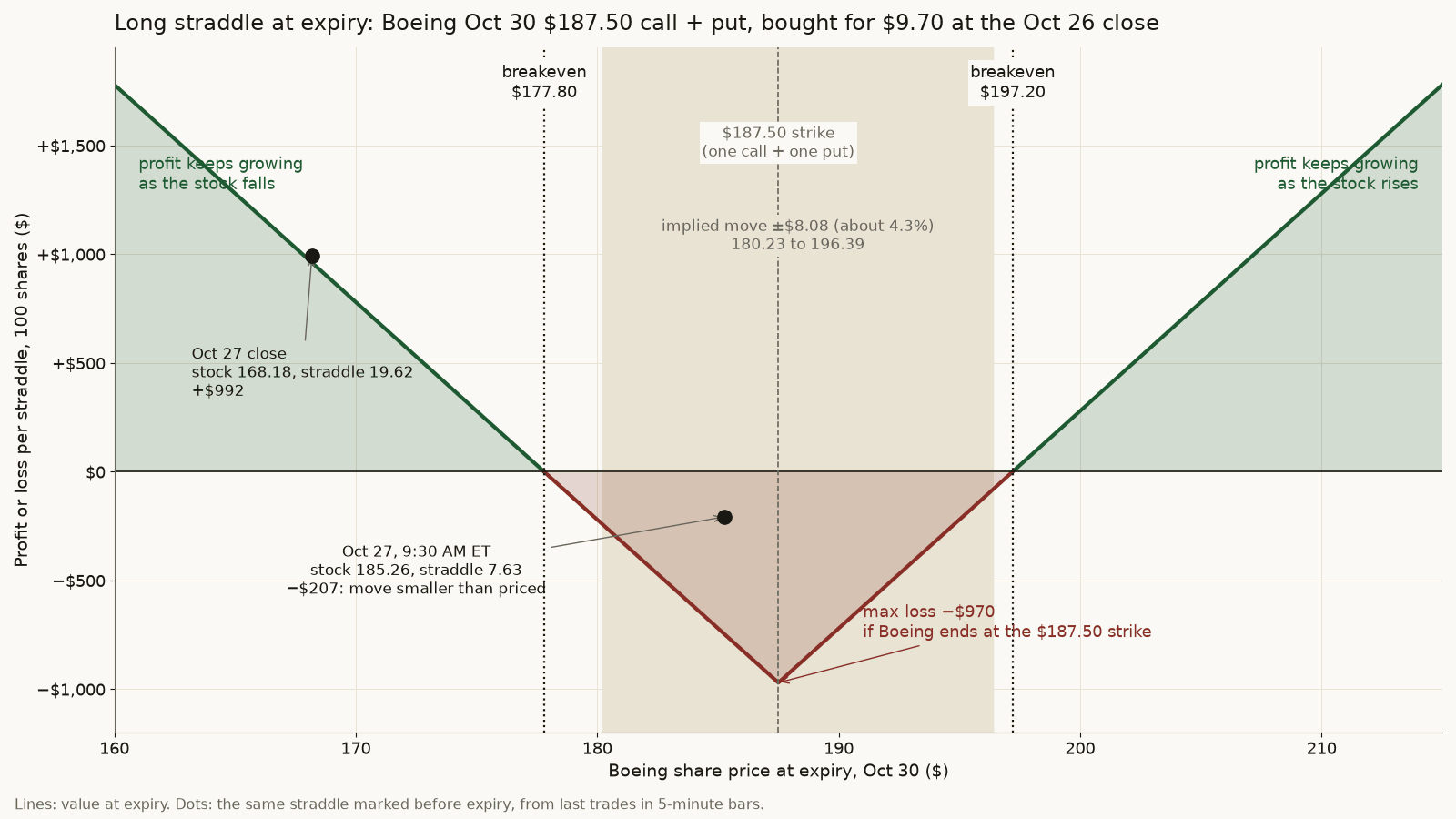
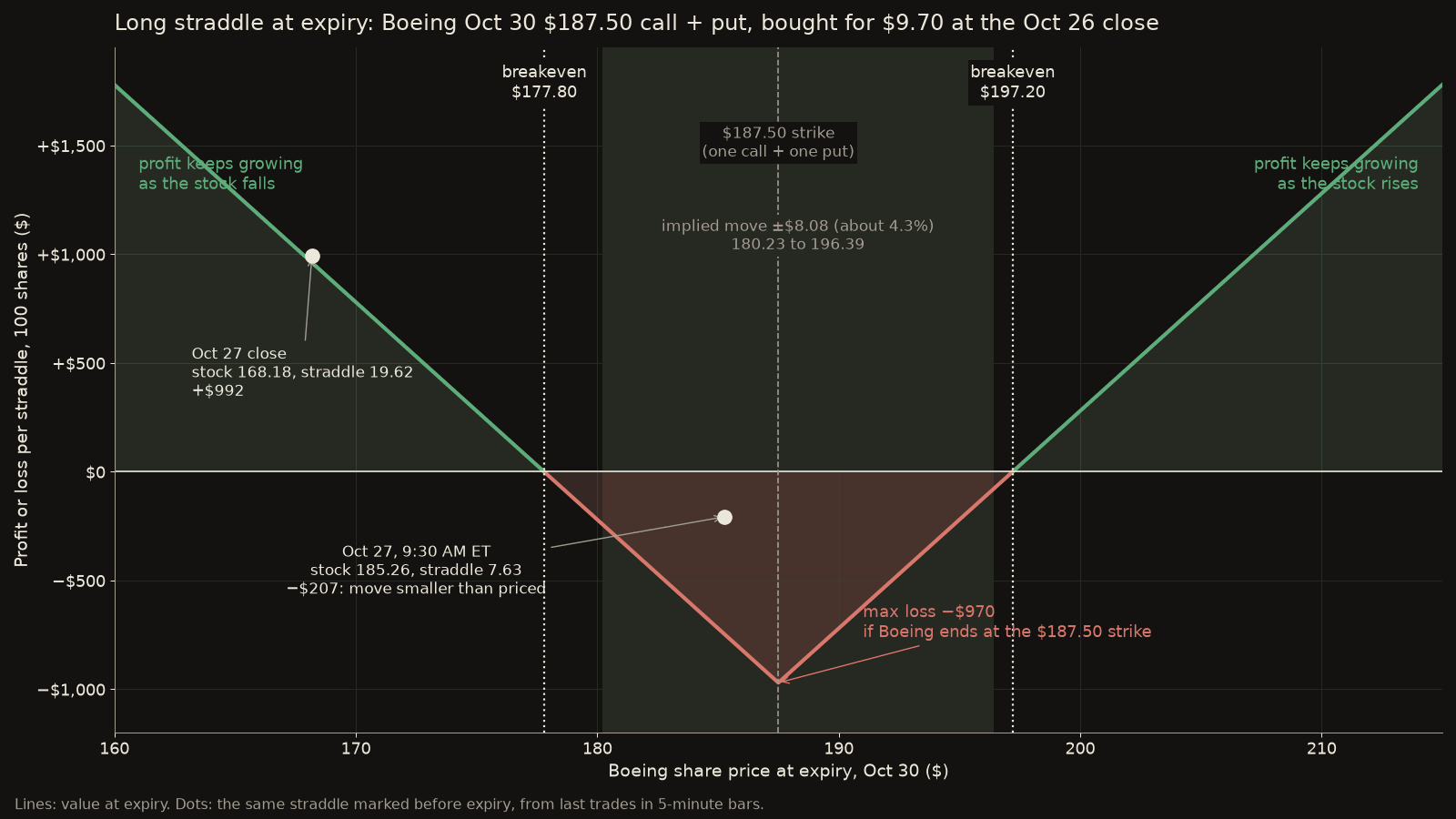
Take the example from the chart. At the 4:00 PM ET close on Monday, October 26, Boeing was $188.31, and the nearest strike was $187.50. The Oct 30 $187.50 call last traded at $5.25 and the put at $4.45 in the final 5-minute bar, so the straddle cost $9.70 a share, or $970 for one contract of each, since each option covers 100 shares. That $970 is the maximum loss, and it happens only if Boeing finishes exactly at $187.50 on Oct 30, when both options expire worthless.
The breakevens are the strike plus and minus the cost: $187.50 + $9.70 = $197.20 and $187.50 − $9.70 = $177.80. Boeing had to finish below $177.80 (about 5.6% lower) or above $197.20 (about 4.7% higher) for the straddle to make money at expiry. Beyond either breakeven, every dollar of movement is a dollar of profit per share, with no cap. Note that the breakevens sat outside the calendar's implied move of about $8.08, or ±4.3%: a straddle bought at the market's price only wins when the move is bigger than the market expects.
Two forces work against the buyer. Time decay takes a little value every day the move doesn't happen, faster as expiry nears, and this straddle had only four days to run. Volatility matters even more around a known event: option prices swell before a report because everyone knows a move is coming, and that extra premium drains out as soon as the news is public. That drop is often called the volatility crush, and it hits the straddle buyer the moment the report lands.
On this week's tape
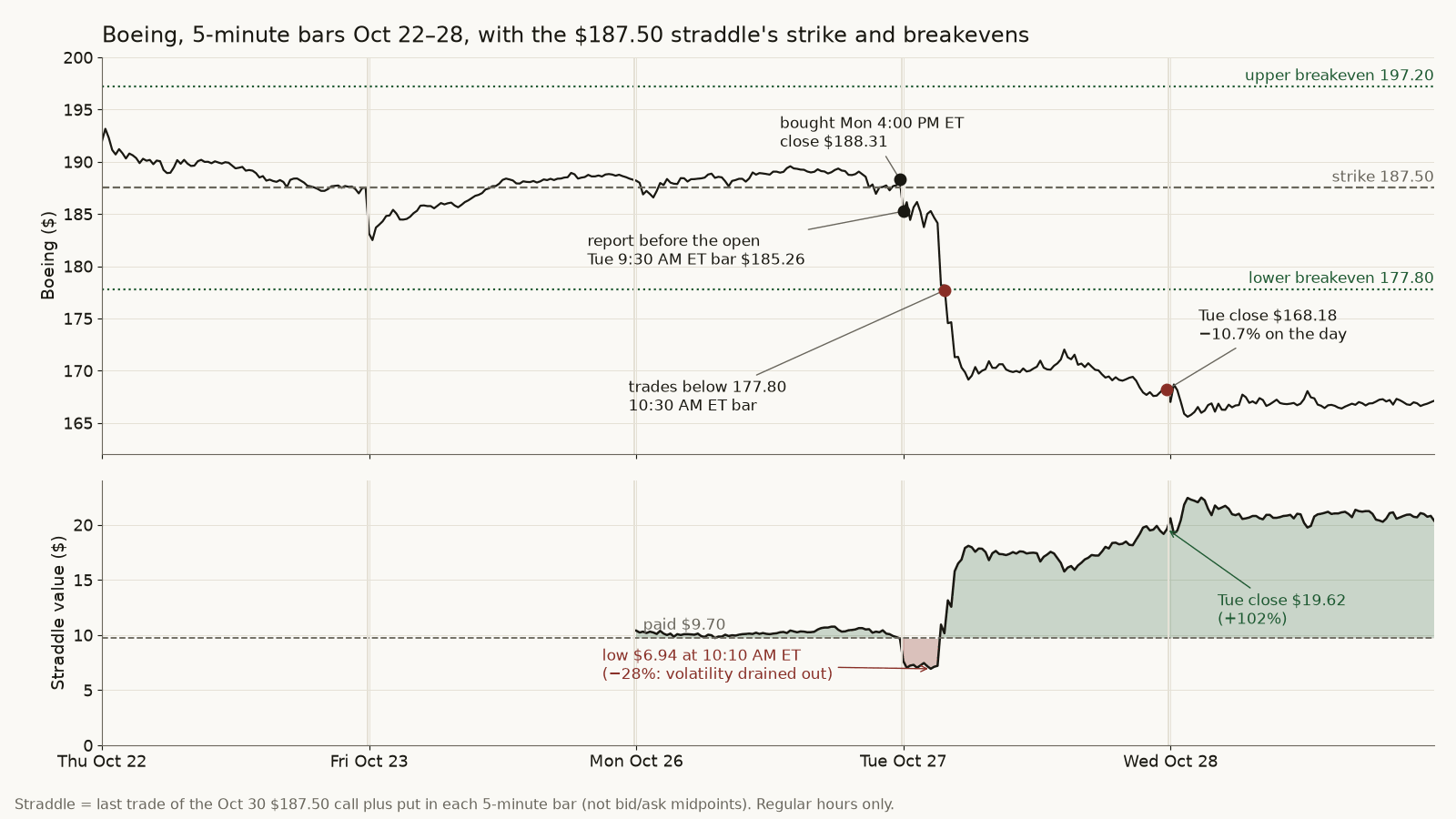
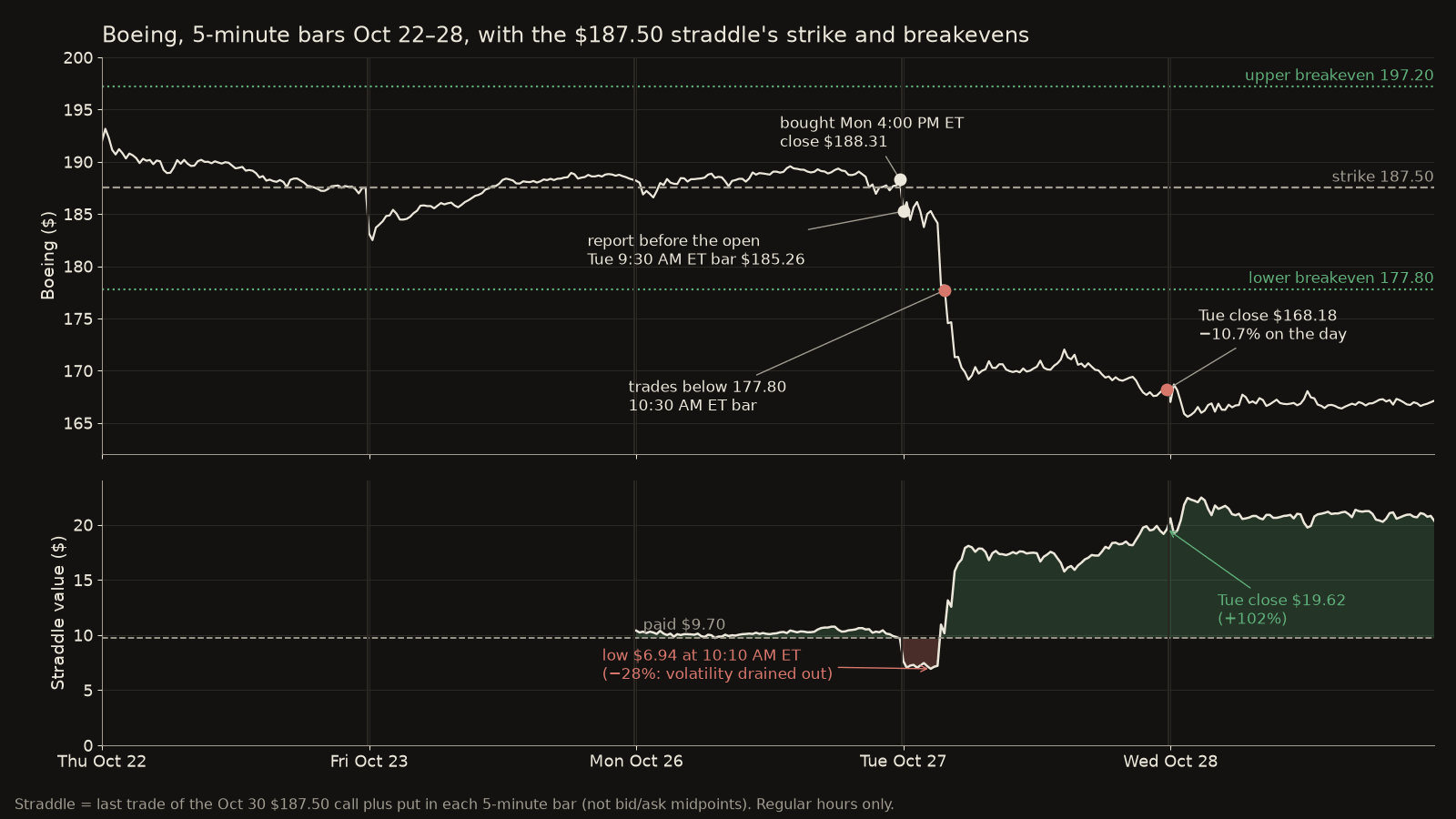
Here is how a hypothetical $187.50 straddle bought at Monday's close would have played out. Boeing opened Tuesday at $183.50, down about 2.6%, and its first 5-minute bar closed at $185.26. That is a real drop, but it was smaller than the move already priced in, and the straddle was marked at $7.63 in that first bar, down about 21% from the $9.70 paid. By 10:10 AM ET it hit its low of $6.94, down about 28.5%, while Boeing was only about 1.6% below Monday's close. The volatility premium had drained out and the stock hadn't moved far enough to make up for it.
Then the selling picked up. In the 10:25 AM ET bar Boeing fell from $184.13 to $178.15, and in the 10:30 AM ET bar it traded below the $177.80 breakeven for the first time, at $177.69. By 11:00 AM ET it was near $169.86 and the straddle was marked near $17.90. Boeing closed at $168.18, and the straddle's last trades put it at $19.62: the put at $19.55 and the call at $0.07. That is about $9.92 a share above the cost, or $992 per straddle, roughly double. By Wednesday's close, with Boeing at $167.14, it was marked near $20.37.
Two honest caveats. These marks come from the last trade in each 5-minute bar, not from what a buyer could have filled at between the bid and the ask, and the spread on short-dated options can be wide on a day like this. And this is a story told with the result already known: the same trade on Coca-Cola, reported the same morning, lost money.
When it fails
A straddle fails when the move is smaller than its price. Coca-Cola reported the same Tuesday morning with an implied move of about 2.7%. At Monday's close, with the stock at $92.70, the Oct 30 $93 call last traded at $1.35 and the put at $1.61, a $2.96 straddle with breakevens at $90.04 and $95.96. Coca-Cola fell about 1.6%, to $91.18, a move that would make a stock owner wince but was smaller than the options had priced. The straddle was marked at $2.12 at Tuesday's close, down about 28%, even though the put leg gained.
The damage is limited by design: the most a straddle buyer can lose is the premium paid, so the risk is known in dollars before the trade. What limits it further is the size of that premium in the account, in general terms keeping any single event bet small enough that losing all of it, as happens if the stock pins the strike, is survivable. Boeing nearly showed the other way it fails, too: had the stock stopped at its opening level, the buyer would have been down about a quarter of the money on a day the stock fell 2.6%.
Common mistakes
The first mistake is thinking an earnings report guarantees a move big enough. The market knows the date too, and the straddle's price already includes the expected move. The question is never whether the stock will move, but whether it will move more than the price of the straddle.
The second is ignoring the volatility crush. Buyers often watch the stock move the right way after a report and still see the straddle lose value, as Boeing's did for its first hour on Tuesday. The third is buying expiries too far out or too close in without thinking: longer expiries cost more and decay more slowly, while a four-day straddle like this one leaves almost no time for the move to show up.
Try it on paper
Pick a company reporting next week. The day before the report, write down the stock price, the strike nearest to it, the call and put prices for the nearest weekly expiry, their total and the two breakevens. Look up the implied move and the stock's last four post-earnings moves, and note whether the past moves were usually bigger or smaller than what options price now. Then check the straddle's price an hour after the open on report day and again at the close. Do this for five reports, and you'll see how often the priced move is too small, too big, or about right.
SOURCES ›
- Earnings calendar, pulled Oct 26–27: BA reported 2026-10-27 premarket, pre-earnings close $188.31, expected move $8.08 (4.29%), EPS est −0.21; KO reported 2026-10-27 premarket, pre-earnings close $92.70, expected move $2.53 (2.73%), EPS est 0.87
- Quotes, daily bars, regular hours: BA Oct 26 close 188.31; Oct 27 open 183.50, high 187.86, low 167.41, close 168.18 (−10.69%); Oct 28 close 167.14. KO Oct 26 close 92.70; Oct 27 close 91.18 (−1.64%)
- Quotes, 5-minute bars, BA Oct 22–28 regular hours (times ET): Oct 27 9:30 AM bar close 185.26; 10:10 AM 185.29; 10:25 AM bar 184.13 to 178.15 (low 178.00); 10:30 AM bar low 177.69; 11:00 AM bar close 169.86
- Options quotes, 5-minute bars, last trades (not bid/ask midpoints), BA 2026-10-30 $187.50 call and put: Oct 26 3:55 PM ET bar close call 5.25, put 4.45 (straddle 9.70); Oct 27 9:30 AM bar call 2.70, put 4.93 (7.63); 10:10 AM bar call 2.44, put 4.50 (6.94, the low between the open and the breakeven cross); 11:00 AM bar 17.90; 3:55 PM bar call 0.07, put 19.55 (19.62); Oct 28 3:55 PM bar call 0.04, put 20.33 (20.37)
- Options quotes, 5-minute bars, last trades, KO 2026-10-30 $93 call and put: Oct 26 3:55 PM ET bar call 1.35, put 1.61 (2.96); Oct 27 3:55 PM bar call 0.23, put 1.89 (2.12)
- Derived: breakevens 187.50 ± 9.70; P&L per straddle = (value − 9.70) × 100; percentages vs the Oct 26 close
- @FirstSquawk — “Core Loss/Share: 34c (est loss/share 21c)”
- @wallstengine — “Following Boeing's cut to its 2026 aircraft delivery outlook, as production increases for the 737 MAX and 787 Dreamliner are taking longer than expected, partly due to engine supply issues.”
Get tomorrow's brief before the open.
Weekdays at 8:30 ET. Free. Unsubscribe anytime. Privacy