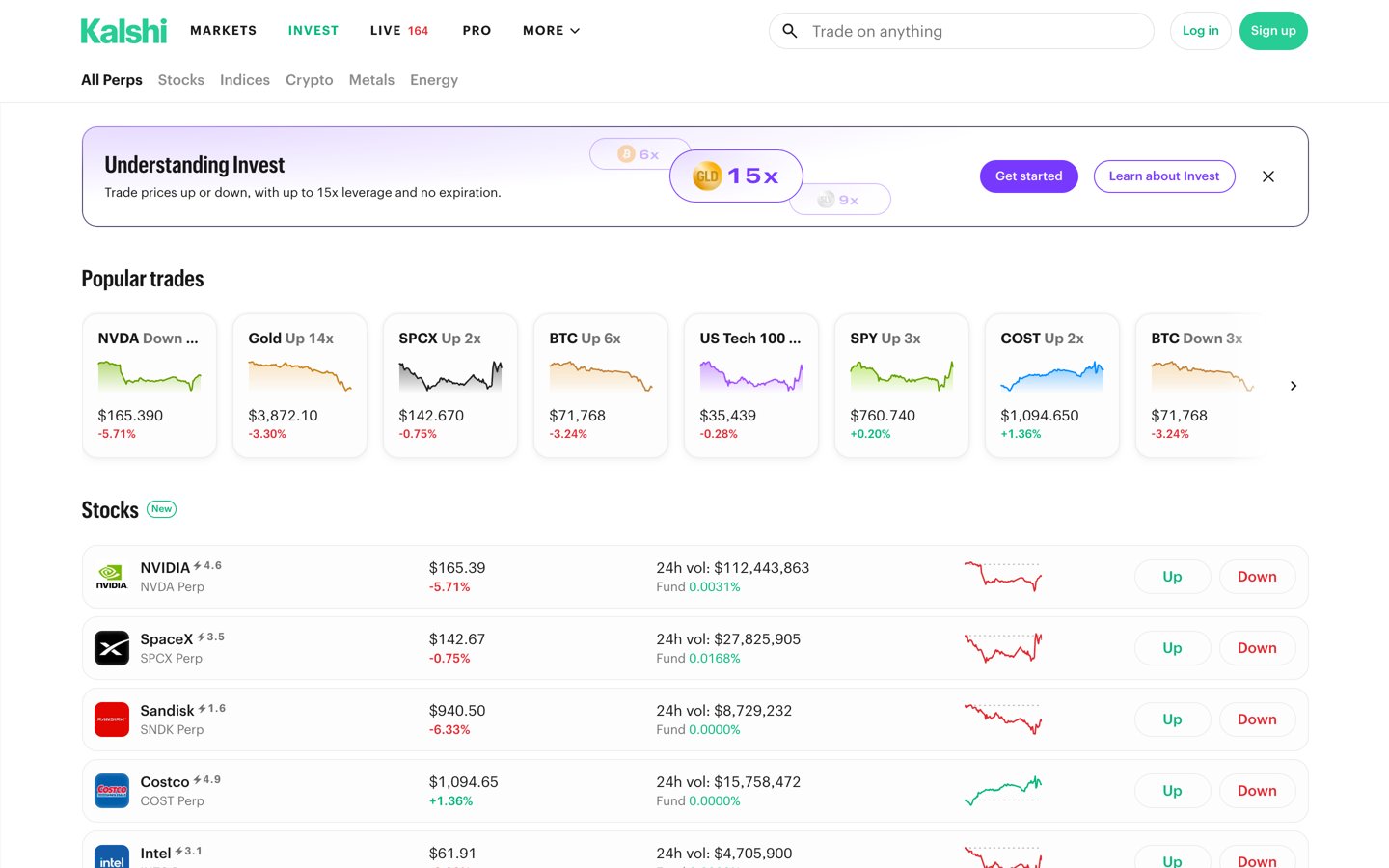
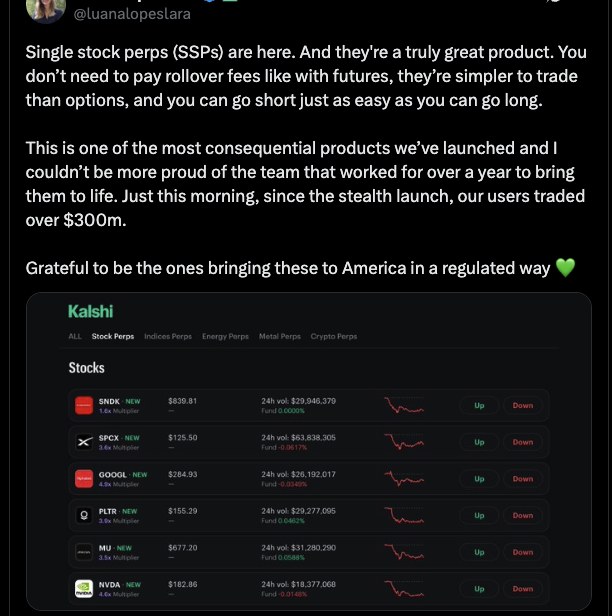
On November 5, Kalshi switched on perpetual futures tied to more than 50 stocks listed on the NYSE and Nasdaq. By that morning, co-founder and COO Luana Lopes Lara said users had already traded more than $300 million.
“You don't need to pay rollover fees like with futures, they're simpler to trade than options, and you can go short just as easy as you can go long.”
A perp is a futures contract with no expiry date. You hold it as long as you like, betting the stock goes up or down, and a small daily payment called funding keeps its price close to the real share price.
How a Kalshi stock perp works
- Each contract tracks 0.02 of a share, so 50 contracts move like one share. The smallest position is one contract, about $4 on a $200 stock.
- Leverage is set per stock and shown on each market. Kalshi's own example: 50 contracts with $50 of margin at 4x gives you $200 of exposure.
- Funding is worked out once a day at 4 PM ET. When the rate is positive, longs pay shorts; when it's negative, shorts pay longs.
- Trading fees are charged when you open and when you close, on your full exposure including leverage.
- Stock perps keep set trading hours. They aren't open around the clock.
Who runs it
Kalshi is a CFTC-regulated exchange (a designated contract market). Stock perps clear through Kalshi Klear, its CFTC-regulated clearinghouse, and are offered through Kalshi Prime, a registered futures broker. Because they're tied to single stocks, they count as security futures, which the SEC oversees too.
Getting access
Perps sit in their own account, apart from your prediction-market balance. Once your Kalshi account is verified, you apply for perps access, finish a short tutorial, then fund the perps account by ACH or wire.
WHAT TO TAKE FROM IT
Perps make it cheap to take a big position on a single stock, in either direction. That's the appeal and the danger: with leverage, a move against you hits your margin several times as hard.
Look around Kalshi yourself
A CFTC-regulated US exchange for event contracts on the Fed, inflation, earnings and more.
Who can use it: Kalshi serves US traders and many other countries. Its member agreement lists where it doesn't operate, and it checks your location when you sign up.
mrkts earns a referral reward if you sign up and trade. Not available everywhere; our link checks your region.
The risks
- One trader's result says nothing about what you'll make. Most people who trade these markets don't end up ahead.
- Leverage works both ways. A small move against you can use up your margin and close your position.
- Funding is charged every day you hold, so a position can lose money even when the stock goes nowhere.
- Fees are charged on your full leveraged exposure, not just the margin you put up.
Sources (3)
More market stories
Get the Desk's daily market feature, free.
One feature a day, every day. Free. Unsubscribe anytime. Privacy
We report what traders did from public sources, listed above. It isn't a tip to copy any trade, and nothing here is investment advice. See our disclosures.