- An iron condor is a range bet with a fixed worst case: sell a put spread below the stock and a call spread above it, collect cash up front, and keep it if the stock ends between the short strikes.
- At 11:34 AM ET a hypothetical Nvidia Nov 20 condor at 135/140/165/170 collected $2.11 against a $2.89 max loss, with breakevens at $137.89 and $167.11, almost exactly the range the $15.10 straddle prices.
- It works when the move comes in smaller than priced and volatility drains out after the report; it fails on gaps like Nvidia's 13.1% drop at the Nov 12 open, and the classic mistake is reading the credit without the risk.
Key numbers
Iron condor
- Sell an out-of-the-money put and buy a cheaper put a few dollars below it: that is the put spread.
- Sell an out-of-the-money call and buy a cheaper call the same distance above it, on the same expiry: that is the call spread.
- Add the two credits: that is the max profit, kept in full if the stock ends between the two short strikes at expiry.
- Max loss is one spread's width minus the credit; the breakevens are the short put minus the credit and the short call plus the credit.
- Before a report, compare those breakevens with the range the at-the-money straddle prices, so you know whether you are selling inside or outside the expected move.
Get the Desk's features and the market mood in your inbox. Free.
One feature a day, every day. Free. Unsubscribe anytime.
Nvidia reports after the close today, and at 11:34 AM ET its stock was $153.63, down about 1.6% on the day and about 11.6% below last Wednesday's $173.73 close. Options are pricing a big move: Friday's $152.50 straddle, one call plus one put, cost $15.10, about 9.8% of the share price. Three weeks ago this column covered the long straddle, the trade that wins when the move beats that price. The iron condor is its mirror image. It wins when the move falls short.
What it is
An iron condor is four options on the same expiry: a put spread below the stock and a call spread above it, both sold for a credit. The trader takes in cash up front and keeps all of it if the stock finishes between the two short strikes at expiry. It is a bet on a range, not a direction. The stock can drift up or down and the trade still works, as long as it does not travel too far. Because each spread has a bought option on the outside, the most the trade can lose is fixed on the day it is opened.
How it works
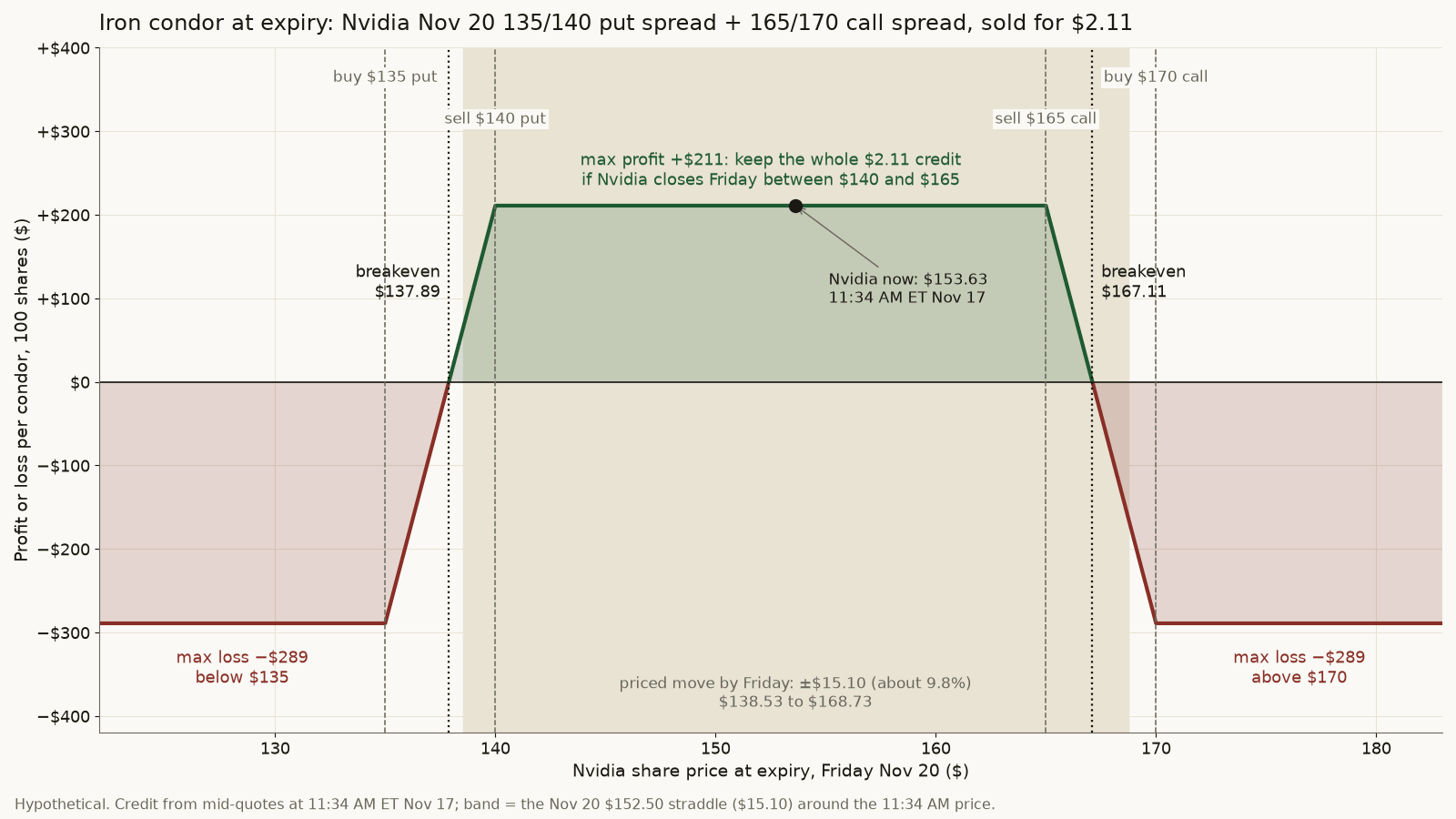
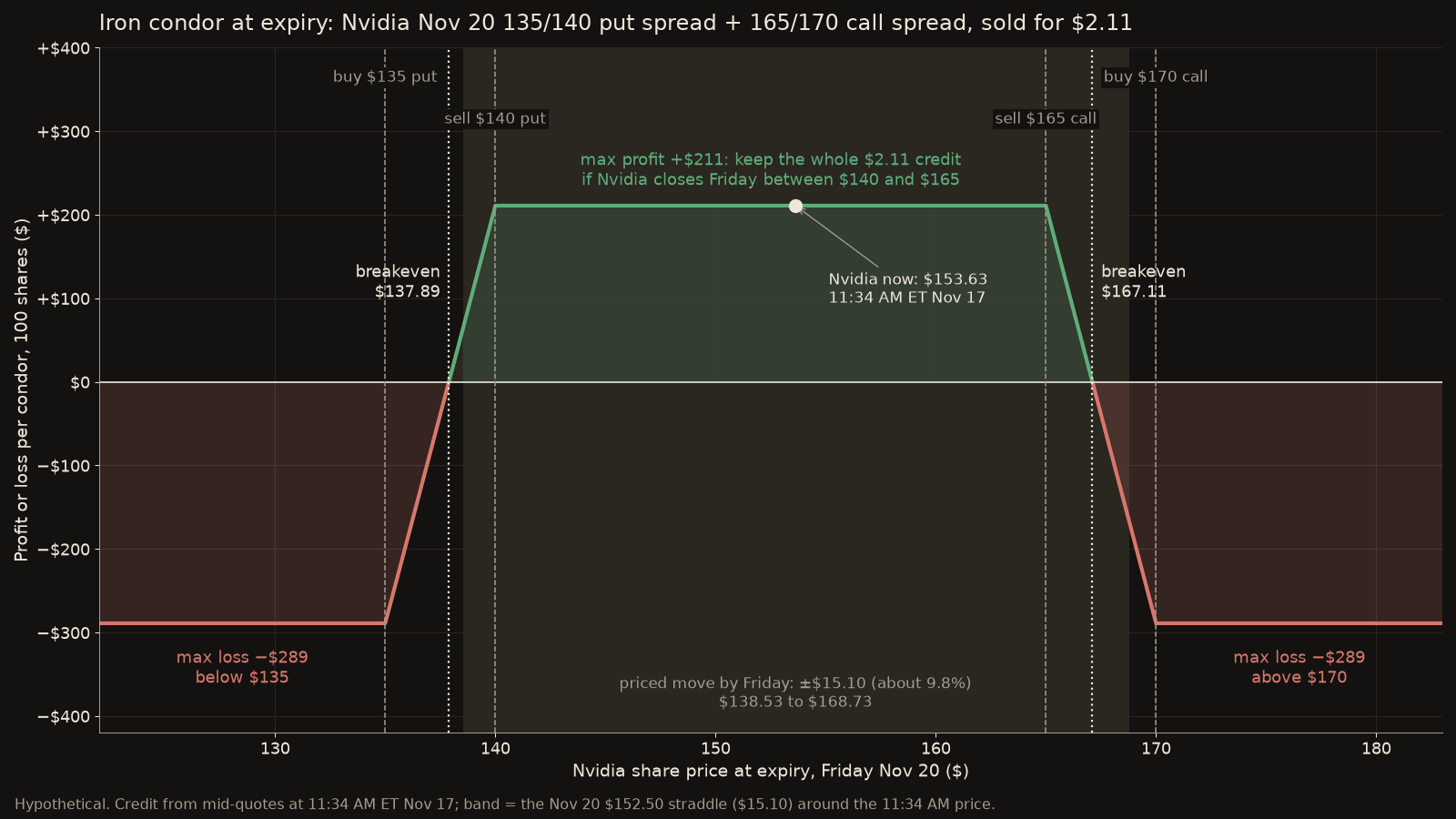
Here is a hypothetical condor on Friday's Nov 20 expiry, priced at mid-quotes at 11:34 AM ET. Sell the $140 put for about $2.37 and buy the $135 put for about $1.41, a $0.96 credit. Sell the $165 call for $3.35 and buy the $170 call for about $2.20, a $1.15 credit. Together that is $2.11, or $211 for one condor covering 100 shares, and it is the max profit, kept if Nvidia closes Friday anywhere from $140 to $165. Each spread is $5 wide, so the max loss is $5 minus $2.11, or $2.89 ($289), reached below $135 or above $170. The breakevens are $137.89 and $167.11. Time and volatility work for the seller: each day the stock stays in range the options lose value, and after a report implied volatility usually drops sharply, shrinking all four prices at once. The two short options carried implied volatility of about 131% this morning, and that drop is what a condor seller is waiting for.
On this week's tape
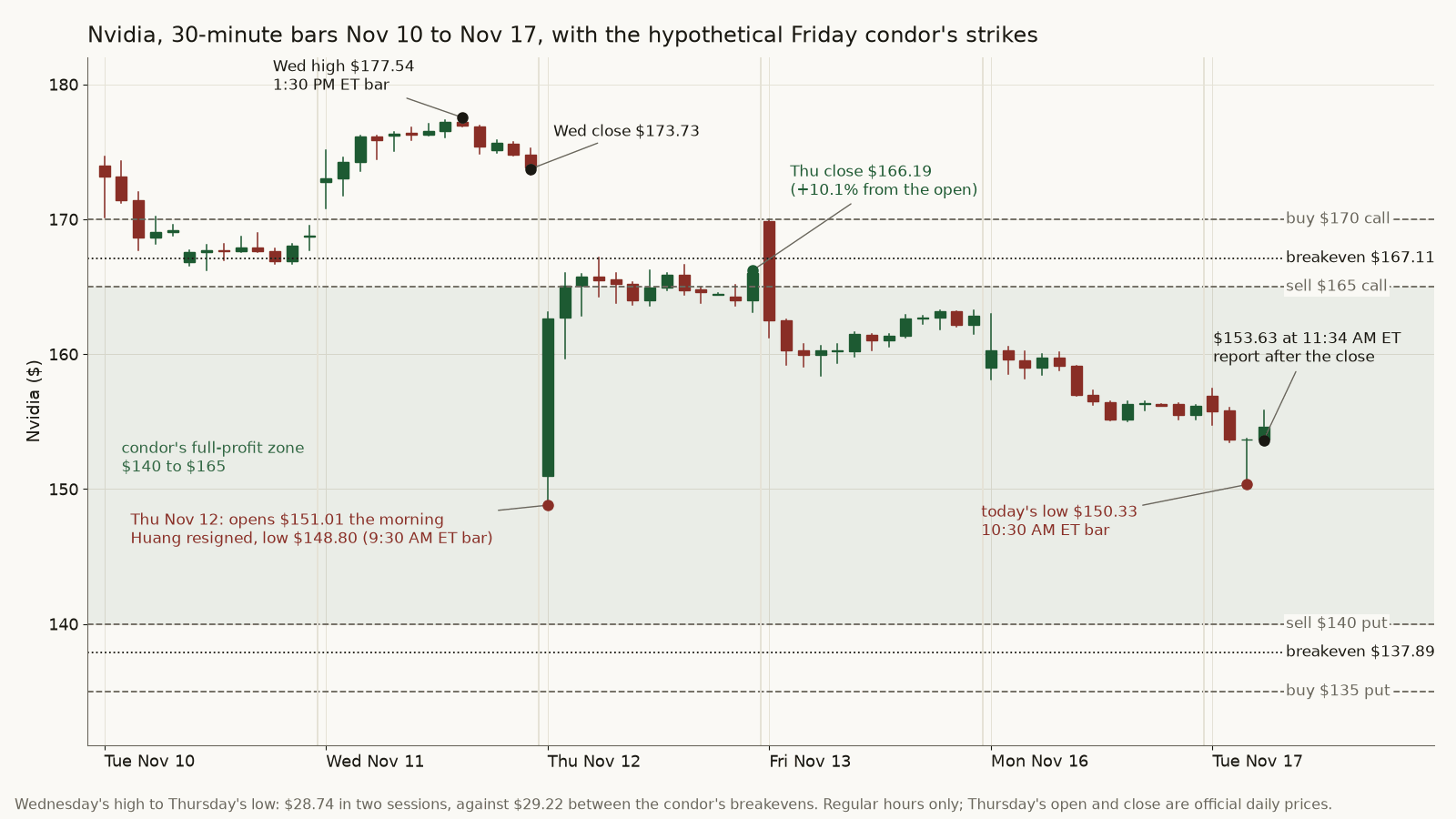
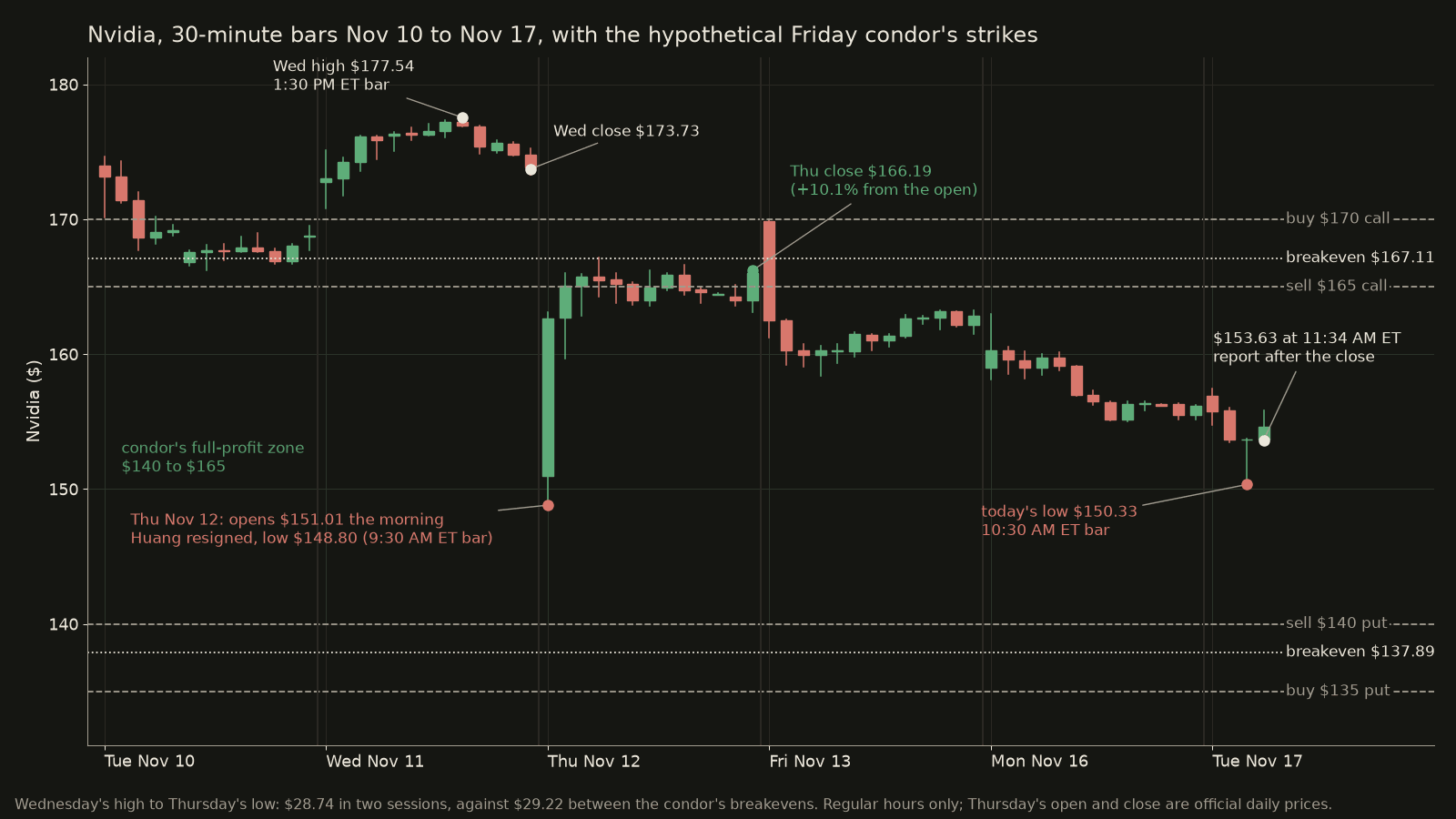
Put the condor's lines on Nvidia's last six sessions and the challenge is plain. From last Wednesday's high of $177.54 to Thursday's low of $148.80, the stock covered $28.74 in two sessions, nearly the full $29.22 between the breakevens. On Thursday, Nov 12, the morning Jensen Huang resigned as chief executive, it opened at $151.01 and closed at $166.19, about 10.1% above its open. Today it dipped to $150.33 in the 10:30 AM ET half hour. The straddle's $15.10 puts the expected range by Friday at about $138.53 to $168.73, almost exactly on top of the condor's breakevens. In plain terms, the market is charging about what the condor collects, so the seller is being paid to bet the move comes in smaller than priced. Over Nvidia's last eight reports, the next-day move beat the implied move three times, and only one, August's +8.7%, was bigger than the 7.4% between today's price and the $165 short call.
When it fails
The condor's enemy is the gap. On Nov 12, Nvidia opened at $151.01, about 13.1% under the prior close of $173.73. A condor built the same way off that close, with its short put about 8.9% lower near $158 and its long put $5 below that, would have opened with the stock under both put strikes, in the max-loss zone of the diagram, with no chance to adjust in between. Two things limit the damage. The long wings cap the loss at the spread width minus the credit however far the stock falls, and size keeps any one condor small enough that a full max loss is survivable. The same day shows the other half of the story: Nvidia closed at $166.19, back inside that hypothetical range, so a trader who bailed at the open locked in a loss the stock later recovered from. The exit plan has to be written before the open, not during it.
Common mistakes
First, reading the credit without the risk. This condor risks $2.89 to make $2.11, so it has to win about 58% of the time just to break even before costs. Second, ignoring the move already priced: short strikes set inside the straddle's range collect more, but they sit where the market expects the stock to land. Third, holding into expiry with the stock between a short and a long strike, say at $167 here, which can leave the short call assigned and the long call worthless, turning a defined-risk trade into a stock position over a weekend. Fourth, forgetting costs: four legs means four bid-ask spreads, and at this morning's quotes, selling at the bid and buying at the ask would have brought in $2.03 instead of $2.11.
Try it on paper
In a paper account, price the same structure on any stock reporting this week. Write down the at-the-money straddle, place the short strikes just outside the range it implies and the long strikes $5 further out, then record the credit, max loss and breakevens. After the report, note where the stock opened, what the condor would be worth, and whether the drop in implied volatility helped more than the move hurt. For Nvidia, check Wednesday's open against $140 and $165, and Friday's close against $137.89 and $167.11.
- SteadyNvidia's CEO shake-upNvidia traded at $153.63 at 11:34 AM ET, down about 1.6% on the day, ahead of its first report since Jensen Huang resigned.
- HeatingThe AI spending boomFriday's Nvidia straddle prices a move of about 9.8% either way, so tonight's report is the next test of the AI spending story.
SOURCES ›
- Earnings calendar (verified): Nvidia (NVDA) fiscal Q3 2027 report Tue Nov 17, 2026, after the close; EPS estimate $2.47
- data/earnings/NVDA.json history (calendar data): next-day move vs implied move for the last eight reports: Aug 26 2026 +8.7% vs ±5.1%; May 20 2026 −1.8% vs ±5.0%; Feb 25 2026 −5.5% vs ±5.2%; Nov 19 2025 −3.2% vs ±6.1%; Aug 27 2025 −0.8% vs ±5.6%; May 28 2025 +3.2% vs ±5.8%; Feb 26 2025 −8.5% vs ±7.7%; Nov 20 2024 +0.5% vs ±7.5% (moves beat implied 3 of 8 times)
- NVDA quote 11:34 AM ET Nov 17: last 153.63, bid 153.61, ask 153.63; previous close Nov 16 156.14 (−1.61%)
- NVDA Nov 20 2026 options, quotes 11:34 AM ET Nov 17 (bid / ask / mark, implied volatility): 135 put 1.39 / 1.42 / 1.405, IV 134.1%; 140 put 2.35 / 2.38 / 2.365, IV 132.4%; 165 call 3.30 / 3.40 / 3.35, IV 130.5%; 170 call 2.19 / 2.20 / 2.195, IV 129.5%; 152.50 put 6.90 / 7.00 / 6.95 and 152.50 call 8.10 / 8.20 / 8.15 (straddle 15.10)
- Condor math from those marks, rounded to the cent: put spread 2.37 − 1.41 = 0.96; call spread 3.35 − 2.20 = 1.15; credit 2.11; max loss 5 − 2.11 = 2.89; breakevens 140 − 2.11 = 137.89 and 165 + 2.11 = 167.11; win rate to break even 2.89 / 5 = 57.8%; natural credit at bid/ask (2.35 − 1.42) + (3.30 − 2.20) = 2.03
- NVDA daily bars (regular hours): Nov 11 high 177.54, close 173.73; Nov 12 open 151.005, low 148.80, close 166.19; Nov 13 close 162.85; Nov 16 close 156.14
- NVDA 30-minute bars (regular hours, ET) Nov 10 9:30 AM to Nov 17 11:30 AM: Nov 11 high 177.54 in the 1:30 PM bar; Nov 12 low 148.80 in the 9:30 AM bar; Nov 17 low 150.33 in the 10:30 AM bar
- @Reuters — “BREAKING: Jensen Huang has resigned as president, CEO and board member of Nvidia effective immediately”
- @CNBC — “Chief Financial Officer Colette Kress will serve as interim CEO until a new leader is appointed, Nvidia said in a Thursday statement.”
Get tomorrow's feature in your inbox.
One feature a day, every day. Free. Unsubscribe anytime. Privacy